

Rosie: Where The Scottish Colourists and The Colour Factory Artists intersect
The coupling of the Colour Factory with the exhibition “Radical Perspectives” is one that myself and my fellow artists are very excited to share with you.
The combination of exhibitions sits as a perfect illustration of now and then. Walking through “The Everyday” exhibition, before looking at the ‘Radical Perspectives’, you can see a clear relationship that runs through. In our exhibition, there are similar themes of painting in the form of the still life, landscapes and in jewellery; each a creation to represent the lens through which each artist sees the world.
When you move through the ‘Radical Perspectives’ exhibition, you may discover a lot of familiar and well-loved art and artists; not just The Scottish Colourists, but also their European contemporaries working at the time. It’s important to note that at the time these paintings were breaking all the academic rules, the public reception and reaction of the salons were ones of outrage and disgust.
Artists have always understood the importance of progression in practice. Painters, like Pablo Picasso, called Paul Cezanne the ‘Father of Modernism’, because Cezanne was an early forger of abstraction with his geometric brush marks in the 1880s. Fauvist artists, like Andre Derain and Henri Matisse, were seen as wild and absurd in their use of clashing colours in the early 1900s. Several of the paintings were rejected by the Salons, but they all had a large impact on the Scottish Colourists and the Bloomsbury group in London.
The Scottish art schools championed the Dutch school of cool still life paintings with peeled fruit against a black background. On returning from their painting trips to the south of France and Paris, the Scottish Colourists were painting and absorbing the light and colour into their paintings. Imagine the contrast when returning home to a very grey Edinburgh.
Advances in painting were also being made by the British contingent of The Bloomsbury group. They lived with a small Paul Cezanne painting of apples that kept the group ignited. Virginia Woolf describes how she came across this scene when she paid a visit to her sister, the artist Vanessa Bell, at Charleston House. Bell, Duncan Grant and their lodger Roger Fry (the art critic) were members of the Bloomsbury Group: ”Roger very nearly lost his senses. I’ve never seen such a sight of intoxication. He was like a bee on a sunflower.” Fry went on to the curate the first ever Post Impression exhibition which opened in London in 1910.
The painters and makers at The Colour Factory collaborate and share their skills with their students and each other. It’s an unusual family of artists working with a strong sense of solidarity and a fearless voice championing the arts when in these times the arts are not seen as a priority, and are often last on the list.
Like the artists who came before them, The Colour Factory artists push their practice, searching for new ways to work and communicate.
In recent times, visual imagery has become something to flick through quickly with little regard, an example of this being how we use social media. A fortunate side effect of this is that the handmade has become more and more important, with public appreciation for it rising, especially since the pandemic. We hope you will see that nothing compares to witnessing art in person, and feeling the artists’ touch in each piece.
I’ll leave you with this quote from J D Fergusson:
I remember when I was young any colour was considered a sign of vulgarity. Greys and blacks were the only colours for people of taste and refinement. Good pictures had to be black, grey, brown or drab. Well! let’s forget it, and insist on things in Scotland being of colour that makes for and associates itself with light, hopefulness, health and happiness…” J.D.Fergusson
Rosie Parmley
Our exhibition runs from Thursday 4th June until Sunday 26th July at The Arc, Winchester. Click here to find out more.
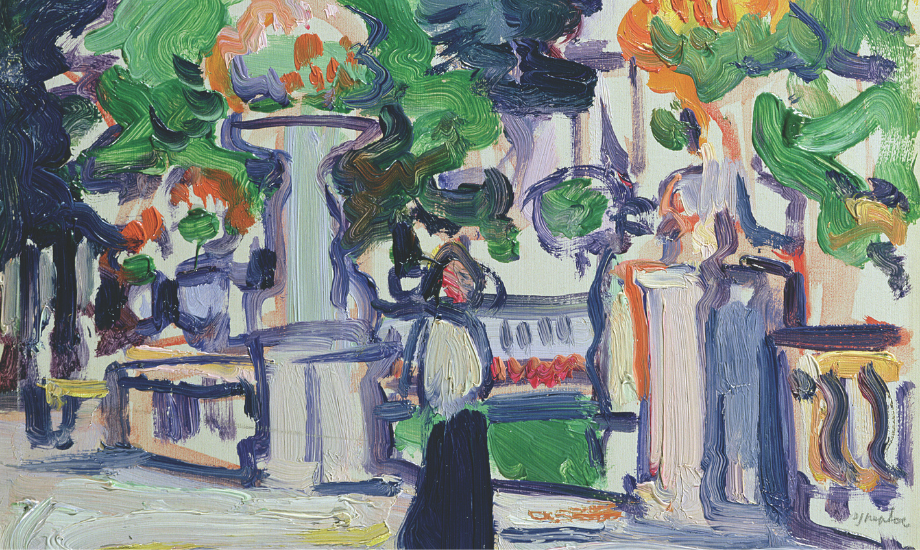
Detail from Luxembourg Gardens, c.1910, SJ Peploe © The Fleming Collection
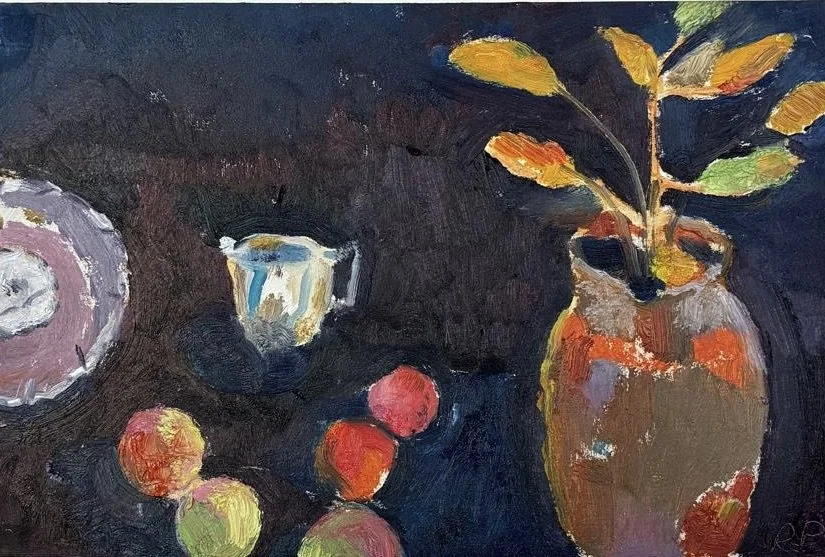
‘Five jostling apples in darks’, Rosie Parmley.